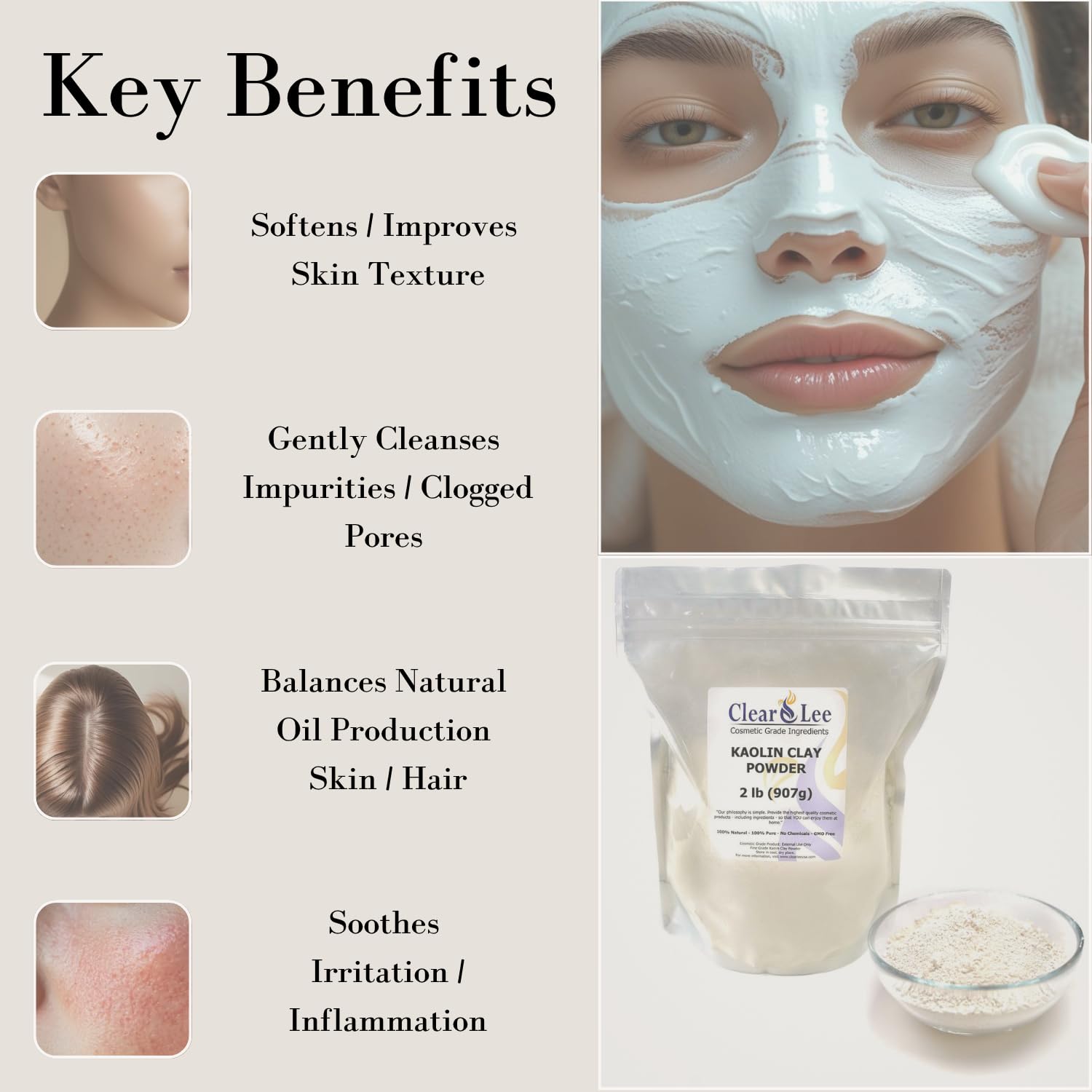
If you’ve ever reached for a clay mask hoping it would “draw out toxins” and left with a tight, uncomfortable feeling instead of glowing skin, there’s a good chance the word kaolin was somewhere on that ingredient list. Kaolin (pronounced KAY-oh-lin) is a soft, white mineral clay — the same family of material used in fine porcelain — and it shows up in more masks, cleansers, and powders than almost any other clay on the market. But here’s the thing the packaging rarely says plainly: kaolin does not detoxify your skin. There are no toxins in your pores for it to pull out. What kaolin actually does is absorb excess oil and moisture from the surface of the skin — gently, without stripping — which makes it one of the most useful ingredients in sensitive-skin and combination-skin formulations. This article breaks down what kaolin really does, where it fits (and doesn’t fit) in a serious skincare routine, which product tier to buy for your specific situation, and the ingredient conflicts you need to know before you add another mask to your shelf.
What Kaolin Actually Does — And Why the “Detox” Label Is Misleading
Let’s start with the science, because the detox mythology is doing real damage to people’s routines.
Kaolin is a phyllosilicate mineral — a layered silicate with a relatively low surface charge compared to other cosmetic clays like bentonite or smectite. That low charge is the whole story. Per the Paula’s Choice ingredient dictionary, kaolin’s mild ionic activity means it attracts and holds oil and moisture without aggressively pulling water from the deeper layers of the skin. It is, in cosmetic chemistry terms, a physical absorbent, not a chemical chelator or ionic exchange medium (which is what bentonite does when it swells and pulls charged particles toward itself).
The practical translation: kaolin sits on the skin, soaks up what’s on the surface, and rinses away. It does not “open pores” (pores don’t open and close — they dilate with heat, but that’s a different mechanism). It does not extract sebum from inside the follicle. It does not remove any biological compound that would qualify as a “toxin” by any clinical standard. The National Center for Biotechnology Information’s review of kaolin in cosmetic and pharmaceutical formulations confirms that its primary documented functions are as an absorbent, a skin-feel modifier (it creates the silky slip many masks and powders are known for), and a mild physical barrier agent.
This matters to your buying decisions in a concrete way: if your goal is deep pore clearing, blackhead reduction, or oil control that lasts more than a few hours, kaolin is not your primary active. It’s a supporting player — and in the right formula, it’s exceptional in that role.
The Kaolin–Bentonite Spectrum: Matching Clay Type to Skin Need
The most common confusion in the clay mask category is treating all clays as interchangeable. They are not.
By the numbers — clay absorbency comparison:
| Clay Type | Oil Absorption Rate | Skin Suitability | Detox Mechanism? |
|---|---|---|---|
| Kaolin | Low–Moderate | Sensitive, dry-combination | None (surface absorbent) |
| Bentonite | High | Oily, acneic | Ionic exchange (limited) |
| French Green | Moderate–High | Normal–oily | Surface absorbent + mineral delivery |
| Rhassoul | Moderate | Sensitive–normal | Ionic exchange (gentle) |
Bentonite, the clay in the Aztec Secret Indian Healing Clay jar that has dominated social media for years, has a significantly higher absorption capacity and a genuine ionic charge mechanism. Byrdie’s comprehensive clay mask guide notes that dermatologists consistently distinguish between the two for this reason: bentonite is effective for oily and acneic skin but can be too stripping for dry or reactive skin types, potentially compromising the skin barrier (the skin’s outermost protective layer, made of lipids and proteins). Kaolin, by contrast, is frequently recommended for people with rosacea, eczema-adjacent sensitivity, or barrier-compromised skin precisely because it doesn’t strip.
The decision frame:
- Oily, acneic, non-sensitive skin + want visible pore reduction → bentonite or French green, not kaolin as the lead ingredient
- Combination or sensitive skin + want oil management without stripping → kaolin is your clay
- Dry skin + want a clay mask at all → look for kaolin plus a humectant like hyaluronic acid or glycerin in the formula; kaolin alone will not add moisture, but it won’t destroy what’s there
Ingredient Conflict Alerts Before You Buy
Every mask recommendation on this site comes with a compatibility check, because layering the wrong actives is one of the most common — and fixable — mistakes in intermediate skincare routines.
Retinoids (retinol, tretinoin, retinal): Do not use a clay mask on the same evening as a retinoid application. Clay masks temporarily reduce surface moisture; retinoids thin the outer skin layer and increase sensitivity. The combination can push irritation response faster than either ingredient alone. Use your clay mask on alternate evenings, or reserve it for mornings if your retinoid is a PM-only treatment. Allure’s guide to actives layering flags this combination explicitly.
Exfoliating acids (AHAs like glycolic and lactic acid; BHAs like salicylic acid): Clay masks are not a substitute for chemical exfoliation, and they should not be stacked on the same day. Some formulas include low concentrations of salicylic acid alongside kaolin — at 0.5–1%, this can be a beneficial combination for congested skin, but the total exfoliation load in your weekly routine still needs to be managed. If you’re using an acid toner daily, your clay mask days are your acid-rest days.
Vitamin C (ascorbic acid, ascorbyl glucoside, sodium ascorbyl phosphate): Vitamin C serums are generally applied in the morning. Clay masks are generally used in the evening or as occasional treatments. These two rarely conflict in practice, but note that clay’s absorbent properties can theoretically pull a vitamin C serum off the skin surface if you’re applying a mask immediately after. Always let actives fully absorb (15–20 minutes) before applying any clay mask over them.
Which Kaolin Mask to Buy — The Tiered Decision Framework
This is where we get into specific buying decisions across price tiers, with the cost-per-use math that tells you what you’re actually paying per treatment (most masks yield 20–30 uses from a standard 75–100ml jar or tube).
Entry Tier ($10–$25): Neutrogena Deep Clean Purifying Clay Cleanser and Aztec Secret as a Kaolin Blend
Neutrogena’s clay cleanser uses kaolin as the lead clay, supported by a gentle surfactant system. At roughly $10–$12 for a 6-oz tube, the per-use cost is well under $1. Reviewers at Byrdie consistently note its reliability for daily use on combination skin without over-drying — an important functional distinction from bentonite-heavy alternatives at the same price point. The tradeoff: it’s a rinse-off cleanser, not a true mask, so dwell time and the ritual experience are minimal.
For those who want a powder-form kaolin option with flexibility to control concentration, some Aztec Secret users mix the powder with water or aloe at lower ratios than the full-strength bentonite formula. Be precise here — the classic Aztec jar is primarily bentonite; you’re working with a different mechanism if you go that route. Read the ingredient list, not the brand name.
Mid-Tier ($45–$85): Tatcha Pore Perfecting Treatment and Herbivore Blue Tansy
Tatcha’s Pore Perfecting Treatment uses Japanese skin-smoothing technology alongside kaolin, with hadasei-3 (a fermentation complex) as the brand’s signature active. At approximately $62 for a 1.2-oz jar — roughly 25–30 uses — the cost-per-use lands around $2.10–$2.50 per treatment. Vogue’s sensitive-skin mask round-up rates it highly for the combination of oil control and skin-feel improvement without post-mask tightness. Worth noting: Tatcha’s formula is well-tolerated by rosacea-prone skin in aggregated user reviews, which is a meaningful differentiator at this tier.
Herbivore Blue Tansy’s mask uses kaolin alongside blue tansy oil (an anti-inflammatory botanical) and white willow bark (a salicylate source). Harper’s Bazaar has highlighted it specifically for combination-sensitive skin. The 2-oz jar at approximately $48 yields roughly 20 uses — about $2.40 per treatment — and the formula’s calming profile makes it a practical weekly reset for reactive skin.
Prestige Tier ($130–$350+): Sisley Paris Deeply Purifying Mask
Sisley Paris’s Deeply Purifying Mask uses kaolin as part of a multi-clay, multi-botanical system. At approximately $130 for 60ml — with dermatologist-informed usage suggesting once or twice weekly, yielding 20–30 applications — the per-use cost is $4.30–$6.50. That sounds high until you benchmark it against the Sisley brand’s broader philosophy: the formula incorporates white lily extract, tropical resins, and a fragrance architecture designed for the full sensory ritual, not just functional delivery. Vogue and Allure’s prestige skincare coverage consistently position Sisley as a formulation-first house, meaning the R&D investment is real rather than purely a price positioning exercise.
If X, then Y — the decision rule:
- If your skin is oily and congested and you want visible results fast → choose bentonite-forward formulas; kaolin-forward options will feel gentler but deliver slower visible change
- If your skin is combination or sensitive and you want sustainable, non-reactive oil management → kaolin-forward formulas are the correct category, and budget determines frequency vs. experience quality
- If you’re a licensed esthetician or pro-adjacent buyer sourcing for treatment room use → Eminence Organics and Bioelements both offer professional-grade kaolin formulations; prioritize bulk pricing and pH compatibility with your treatment protocols over retail pricing
- If you’re at the prestige tier and weighing cost-per-use → Sisley Paris is the benchmark for kaolin in a complex botanical delivery system; La Mer and Phytomer address different mechanisms (lifting, luminescence) and are not pure kaolin comparisons
The Bottom Line on Kaolin
Kaolin is not a hero ingredient. It’s not going to transform acneic, oily skin the way a well-formulated bentonite or a salicylic acid treatment will. What it does — absorbing surface oil, improving skin feel, and supporting the barrier rather than disrupting it — is genuinely useful for a large swath of skin types that have historically been underserved by the “one strong clay fits all” marketing that dominated the category for years.
Getting the clay type right is the foundational call. Everything downstream — price tier, formula complexity, ritual weight — is a secondary optimization. Start with what your skin actually needs, then spend accordingly.