Let’s clear something up first: a clay mask is not a complicated product. It’s a wash-off treatment — you apply a paste containing absorbent mineral clay, leave it on for a few minutes, and rinse it off. The clay does the heavy lifting, drawing excess oil, debris, and surface-level congestion out of the pore (the tiny opening in the skin where oil and sweat are produced). That’s it. No 12-step ritual required, no dermatology degree. If your skin tends to look shiny by noon, feels congested, or breaks out around the nose and chin, a once- or twice-weekly clay mask is one of the most cost-efficient interventions you can make — and it’s genuinely one of the areas where a $20 option can outperform a $60 one, if you’re matching the right clay type to your skin.
This guide is for the reader who already knows the basics and wants to make a confident purchasing decision. You’ve probably tried something in this category before. You’re now asking smarter questions: Which clay type actually matches my skin? What’s the ingredient conflict I should know about? Is the mid-tier product worth 2.5× the price of the drugstore jar? We’ll answer all of those, show the math, and land on clear decision rules.
The Two Clays That Actually Matter for Men’s Skin (and One That Doesn’t Get Enough Credit)
Most clay masks on the market use one of three mineral clays — or a blend. Getting this right is the first decision point, because the formulation determines whether a mask helps or punishes your skin.
Bentonite clay is the aggressive absorber. It carries a strong negative ionic charge, which means it binds to positively charged toxins, excess sebum (your skin’s natural oil), and surface debris, then pulls them toward the surface as the mask dries. Allure’s breakdown of bentonite clay notes that this is why bentonite masks can feel almost magnetic on congested pores — there’s a real mechanism behind that tight-and-tingly sensation. The tradeoff: bentonite is aggressive. On normal-to-dry skin, it can strip the moisture barrier (the top layer of skin that keeps water in and irritants out) and cause flaking or sensitivity. It’s built for oily and acne-prone skin. If that’s you, it’s your clay.
Kaolin clay is the gentler, more misunderstood option. Paula’s Choice’s ingredient dictionary is direct about this: kaolin absorbs oil and helps even skin texture, but it does not “detox” the skin — that word is marketing language with no scientific basis. What kaolin does do is absorb a moderate amount of sebum without stripping the skin’s natural moisture, making it appropriate for normal-to-combination and even sensitive skin types. If you’ve tried a clay mask and ended up tight, flaky, and red, there’s a decent chance you used a bentonite formula when you needed kaolin.
French green clay (illite) doesn’t show up in as many men’s-positioned products, but it sits between bentonite and kaolin in terms of absorption strength and has a long track record in professional spa formulations. Worth knowing if you’re browsing esthetician-adjacent brands.
The conflict you must know before starting any clay mask: Clay masks are physical exfoliants by nature — they abrade the surface layer lightly as they dry and are removed. If you’re already using a retinoid (vitamin A derivative, available by prescription and increasingly over-the-counter — it accelerates cell turnover and is highly effective for anti-aging and acne), an exfoliating acid like AHA (glycolic, lactic) or BHA (salicylic acid), or a high-concentration vitamin C serum, using a clay mask on the same night stacks too many actives at once. Healthline’s overview of kaolin clay and Paula’s Choice’s ingredient conflict guidance both flag this: rotation is the framework. Clay mask nights are a substitution, not an addition.
By the Numbers
| Product | Clay Type | Price (2026) | Cost per Use (est. 20 uses/jar) | Best For |
|---|---|---|---|---|
| Aztec Secret Indian Healing Clay (1 lb) | 100% calcium bentonite | ~$14 | ~$0.70 | Oily/acne-prone |
| Neutrogena Pore Refining Exfoliating Cleanser | Kaolin blend | ~$10 | ~$0.50 | Normal/combination |
| Kiehl’s Rare Earth Deep Pore Cleansing Masque | Amazonian white kaolin | ~$42 | ~$2.10 | Normal/combo/mild oily |
| Origins Clear Improvement Active Charcoal Mask | Kaolin + charcoal | ~$32 | ~$1.60 | Congested/oily |
| Brickell Men’s Clarifying Charcoal Face Mask | Kaolin + bentonite blend | ~$28 | ~$1.40 | Combo/oily |
| Baxter of California Clay Mask | Kaolin + green tea | ~$38 | ~$1.90 | Sensitive-to-normal |
Estimates assume approximately 20 full-face applications per standard 3.4–5 oz container. Prices reflect May 2026 retail averages.
The Honest Tier Breakdown: Which Product Is Actually Worth Your Money
The $10–$20 Range: More Powerful Than It Has Any Right to Be
The category benchmark here is Aztec Secret Indian Healing Clay. It’s 100% calcium bentonite clay in a jar — nothing else. You mix it yourself, typically with apple cider vinegar (which lowers the pH and activates the clay’s ionic charge) or water for a gentler effect. Reviewers across Byrdie and Allure consistently point to it as one of the most dramatically effective pore-clearing masks available at any price — not because of brand engineering, but because it’s an unusually pure, high-swelling bentonite with no filler ingredients diluting the active mineral.
The catch: the DIY-mixing requirement creates inconsistency, and the formula has no built-in soothing agents. On sensitive or dry skin, the stripping effect can be significant. Vogue’s roundup of men’s face masks calls this a product that “delivers results that would embarrass masks costing ten times as much — if, and only if, your skin can handle it.”
Decision rule: If you have oily or acne-prone skin and no current sensitivity concerns, this is your category winner on cost-per-use. If your skin skews normal, combination, or reactive, pass and move up the tier.
The $28–$42 Range: The Sweet Spot With Formulation Intelligence
This is where formulation quality starts to matter as much as raw clay potency. Three options worth examining:
Brickell Men’s Clarifying Charcoal Face Mask (~$28) uses a bentonite-kaolin blend with activated charcoal (a carbon-based additive that further binds surface impurities) and aloe vera. The blend moderates bentonite’s aggression while keeping the oil-absorption story intact. Reviewers on Byrdie note it as one of the few men’s-specific masks that doesn’t feel like an afterthought — the texture is intentional, and the activated charcoal gives it visual distinction. At roughly $1.40 per use, it represents a meaningful step up in skin-compatibility without the premium tax.
Origins Clear Improvement Active Charcoal Mask (~$32) is the most reviewed product in this tier across aggregated beauty media. Byrdie and Allure have both named it a category staple — kaolin plus white china clay plus activated charcoal, with no fragrance-heavy botanicals that might irritate. It’s formulated broadly enough to work across skin types but is best suited to congested and oily skin. At ~$1.60 per use, the cost-per-use math is defensible against the Aztec Secret if you value a ready-to-use, esthetician-safe formulation over the DIY version.
Kiehl’s Rare Earth Deep Pore Cleansing Masque (~$42) uses Amazonian white kaolin — a finer-grade particle that absorbs oil without the drying edge of bentonite. Refinery29’s men’s skincare guide calls out Kiehl’s Rare Earth as the recommendation they make to male readers asking for “something that works but won’t wreck my face.” It includes aloe vera extract as a built-in soothing offset, which matters if you’re shaving regularly (shaving is mechanical exfoliation — it removes surface skin cells — so post-shave skin is already more sensitized). At ~$2.10 per use, it’s the most expensive in this tier, but for normal-to-combination skin where bentonite is too aggressive, it’s the right tool.
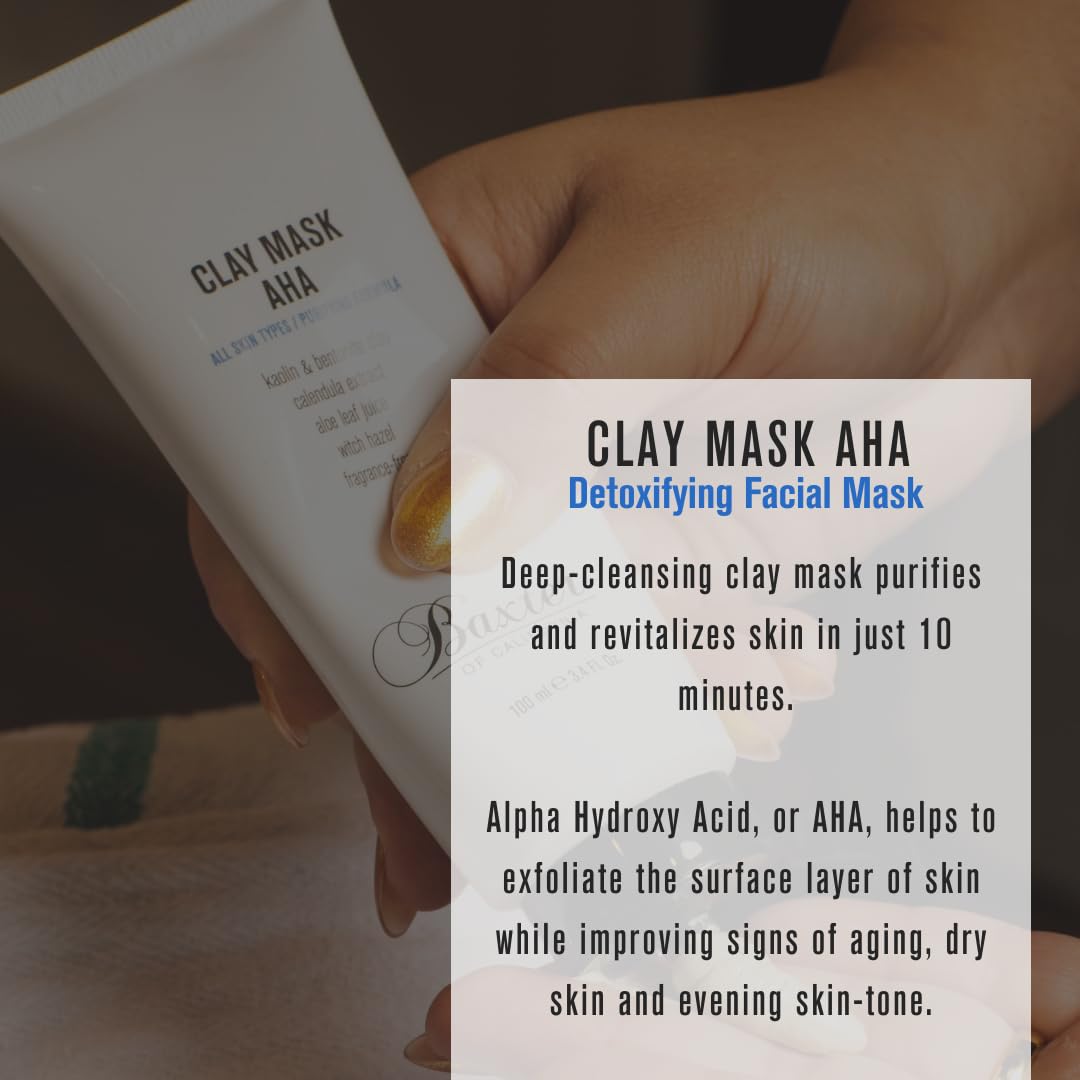
Baxter of California Clay Mask (~$38) occupies an interesting niche: kaolin-based with green tea extract (an antioxidant that helps reduce inflammation), positioned explicitly for a men’s grooming routine. Vogue’s men’s category overview notes it as a “texture-first” formulation — meaning the user experience (thick but spreadable, no dripping, no strong scent) is engineered with a male grooming context in mind. If ritual adherence is a factor — you’re more likely to use a product that feels good — this is worth the modest premium over the Origins.
The $55–$58 Ceiling for This Guide: When Does Prestige Add Real Value?
At the top of this guide’s price range, you’re looking at formulations like Peter Thomas Roth Irish Moor Mud Purifying Black Mask (~$58). This uses a peat-derived mud rather than mineral clay — biologically different in origin, with a richer texture and a higher concentration of organic acids. Allure’s review notes it consistently overperforms for oily skin types in terms of smoothing and pore-refining effect, with a texture that reads more like a prestige spa product than a mass-market mask.
The cost-per-use math here: ~$58 for approximately 20 uses lands at ~$2.90 per application. That’s not outrageous for a results-driven product, but it is a premium you’re paying partly for texture and sensorial experience. If you care about that, it’s money well spent — a product you enjoy using is a product you’ll use consistently, and consistency is the variable that drives results. If you just want clean pores and don’t care about the ritual layer, Origins at $1.60/use delivers comparable pore-clearing outcomes.
Decision Rules: The “If X, Then Y” Framework
If your skin is oily or acne-prone and budget is your primary constraint: Aztec Secret Indian Healing Clay at ~$14, mixed with water (not apple cider vinegar, if you’re new to it). Use once a week, 10 minutes maximum. Skip it on nights you’ve used a retinoid or exfoliating acid.
If your skin is normal to combination and you shave regularly: Kiehl’s Rare Earth ($42) or Baxter of California ($38). Kaolin-based, aloe-assisted, formulated with post-shave skin in mind. Apply 24 hours after shaving, not immediately after.
If you’ve had a bad experience with clay masks (tightness, flaking, redness): You almost certainly used bentonite on skin that needed kaolin. Start with Kiehl’s Rare Earth or Baxter — two to three times, then reassess.
If you’re buying for a treatment room or recommending to clients with varied skin types: Origins Clear Improvement is your broadest-compatibility choice. Kaolin base, no aggressive fragrance, predictable performance across skin types from normal-oily to congested. Stack it against the Brickell for a before-and-after comparison in consultation.
If you’re already using a retinoid or AHA/BHA: Assign clay mask nights to a separate rotation — Tuesday and Saturday, while retinoid runs Monday, Wednesday, Friday. No same-night stacking of any clay mask with an active exfoliant, regardless of which product you choose. Paula’s Choice’s ingredient conflict documentation is the clearest available resource on managing this schedule.
The market is not short on options, but it is short on honest guidance about which clay type matches which skin. Get that first decision right, and the rest of the selection becomes straightforward.