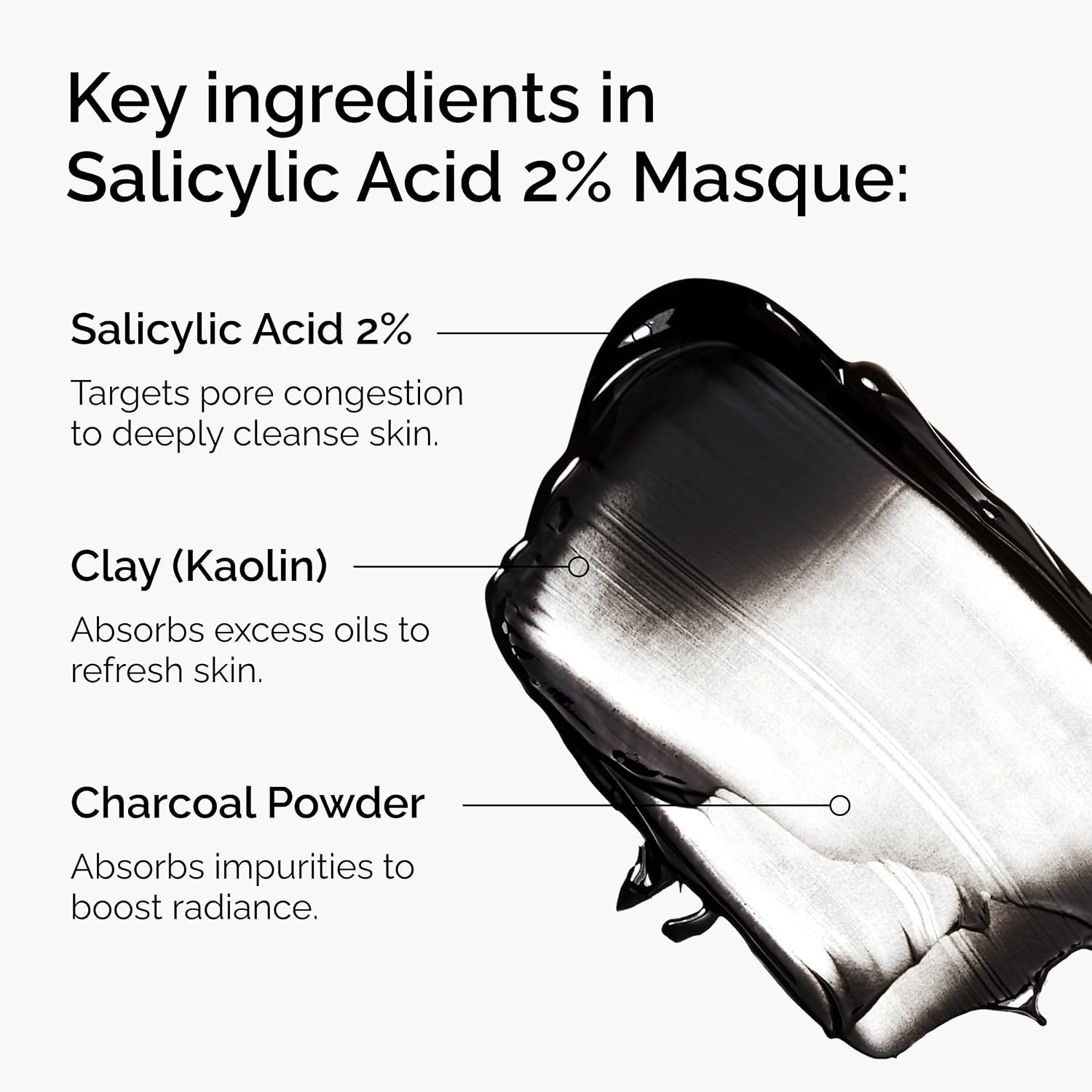
If you’ve ever grabbed a clay mask off the shelf hoping it would clear up breakouts — only to end up with skin that felt tight and stripped — you’ve already experienced the mismatch at the center of this topic. Clay masks work by physically drawing excess oil and debris out of pores, but not all clays do the same job, and most of them don’t address the actual biological cause of acne on their own. That’s where BHA comes in. BHA stands for beta-hydroxy acid, and the most common one in skincare is salicylic acid — an ingredient that works inside the pore (because it’s oil-soluble, meaning it can travel through the sebum that lines your pores) to dissolve the clogs that eventually become blackheads, whiteheads, and inflamed breakouts. When the right clay and the right BHA are formulated together, you get a mask that both purges surface congestion and interrupts the process that causes it. This guide breaks down how to read formulas, make smarter product comparisons, and avoid the ingredient combinations that can quietly sabotage your skin.
Why Clay Type Is the Decision That Comes First
Here’s the mistake most intermediate buyers make: they treat “clay mask” as a category, when it’s actually a delivery format for several chemically distinct materials. Getting the clay wrong means even a well-dosed BHA can’t compensate.
Kaolin is the gentler workhorse. It’s a fine-particle clay that absorbs excess sebum without aggressively pulling moisture from the skin itself. Paula’s Choice’s ingredient database notes that kaolin is appropriate across skin types, including combination and sensitive skin that also happens to be acne-prone — a common pairing that often gets ignored. Kaolin is not a “detox” clay in any meaningful biochemical sense; it doesn’t chelate heavy metals or pull toxins. What it does is absorb oil and provide a mild astringent effect. That’s genuinely useful for acne, but it’s not the whole story.
Bentonite is the higher-draw clay, swelling as it absorbs moisture and oil from the skin’s surface. This is the clay in the famous Aztec Secret Indian Healing Clay jar, and it earns its reputation for pore-visible results — reviewers across aggregated feedback consistently describe visible softening of blackheads and a temporary tightening effect. The tradeoff: bentonite’s moisture-draw is non-selective. It pulls water from your skin alongside the sebum. For oilier skin types, that’s manageable. For combination or dry-acne-prone skin — a presentation that Allure’s coverage of hormonal acne notes is far more common than the industry has historically acknowledged — repeated bentonite use without a humectant follow-up can compromise the moisture barrier, triggering rebound oil production and more breakouts. The medicine becomes the problem.
Kaolin + bentonite blends are how most mid-tier and prestige formulas thread this needle. The kaolin moderates bentonite’s aggression, and you get meaningful absorption without full barrier stress. When you’re evaluating a formula, look for this combination in the INCI (International Nomenclature of Cosmetic Ingredients) list — that’s the standardized ingredient list required on all cosmetic labels — before you get excited about the BHA percentage.
French green clay (also called illite) sits between the two in draw strength and carries trace minerals. It’s frequently used in professional-grade body mud treatments — Éminence Organics and Bioelements both deploy illite-family clays in their spa-grade protocols — but in an at-home acne mask, its advantages over a well-balanced kaolin/bentonite blend are marginal for most users. It’s a formulation signal of quality more than a meaningful functional upgrade.
How BHA Actually Functions Inside a Mask Format — and Why Concentration and pH Both Matter
Salicylic acid at 0.5–2% is the FDA-approved OTC range for acne treatment. That percentage is only part of the equation, though. As the NCBI’s comprehensive review of salicylic acid as a peeling agent makes clear, BHA is pH-dependent: it needs to be formulated at a pH of roughly 3.0–4.0 to remain in its active, free-acid form. Above that range, it converts to a salt that sits largely inert on the skin. This is why a mask that lists salicylic acid at 2% but is formulated at a skin-neutral pH of 5.5 may deliver less than a competing formula at 1.5% with a properly acidic vehicle.
Brands rarely publish their pH values. The practical workaround: look for masks where salicylic acid appears in the top third of the ingredient list (indicating meaningful concentration), and where the formula includes no buffering agents directly after the acid (like sodium hydroxide or triethanolamine) that suggest heavy pH adjustment. This is the kind of signal a formulation-literate buyer can read without needing lab access.
The mask format itself is worth defending here, even against legitimate criticism that rinse-off products have limited dwell time. Harper’s Bazaar’s coverage of salicylic acid masks notes that the occlusive quality of a clay mask — the way it sits semi-sealed against the skin — does increase active penetration time compared to a cleanser. A leave-on 2% BHA serum will still outperform any rinse-off format for ongoing acne management. But a well-formulated mask offers a concentrated, once- or twice-weekly intervention that clears accumulated congestion in a way that a daily leave-on product, used conservatively, often can’t match. They aren’t competing; they’re sequencing.
The Ingredient Conflict Map You Need Before You Buy
This matters more in an acne routine than almost any other category because acne-prone skin users are statistically the most likely to be running multiple actives simultaneously — often retinoids, vitamin C, and exfoliating acids alongside a clay mask. Here’s where the conflicts live:
Retinoids + BHA clay masks: The combination isn’t contraindicated in principle, but the timing has to be right. Using a salicylic acid mask on the same evening as a retinoid (tretinoin, retinol, adapalene) stacks two sources of skin cell turnover acceleration and barrier stress. Dermstore’s guidance on layering actives recommends a minimum 24-hour separation for those with reactive or compromised skin — and for anyone still calibrating their retinoid tolerance, that window should extend to 48 hours. The risk isn’t a dramatic reaction; it’s cumulative barrier erosion that shows up as patchy dryness and increased sensitivity three or four weeks in.
Vitamin C (L-ascorbic acid) + BHA clay masks: Both are most effective at low pH. Using them in the same session isn’t dangerous, but it’s redundant — your skin can only absorb so much at once, and you’re occupying the same biochemical real estate. More practically, L-ascorbic acid is already unstable; the clay mask’s other actives can accelerate oxidation if the products come into contact. Use vitamin C in your morning routine, BHA clay masks at night.
AHAs (glycolic acid, lactic acid) + BHA clay masks: Some prestige masks include both AHA and BHA. When the concentrations are calibrated — typically AHA at 5–10% and BHA at 1–2% — this is a legitimate formulation strategy with research support, as published in several NCBI-indexed dermatology studies on combination acid therapy. But pairing an AHA + BHA mask with a separate AHA toner or exfoliant in the same routine is where users consistently over-exfoliate. One active-heavy format per session is the operating rule.
The Decision Framework: Matching Formula to Skin Architecture
| Skin presentation | Clay priority | BHA target | Watch for |
|---|---|---|---|
| Oily, congested, resilient | Bentonite-forward blend | 2% salicylic acid | Drying down to 10 min max |
| Combination, T-zone acne | Kaolin/bentonite blend | 1–2% salicylic acid | Moisture barrier follow-up |
| Dry-acne-prone (common in hormonal acne) | Kaolin-dominant | 0.5–1% salicylic acid | Retinoid separation schedule |
| Sensitive + acne-prone | Kaolin only | 0.5% BHA or willow bark extract | Fragrance-free formulas only |
The “if X, then Y” decision rules:
-
If your skin is oily and congested with visible enlarged pores: a bentonite-dominant mask with 2% salicylic acid used 1–2x weekly is the most efficient tool. Aztec Secret Indian Healing Clay, mixed with apple cider vinegar (which provides the acidic pH the BHA needs to activate), remains genuinely hard to beat on cost-per-use math. A 1-pound jar running roughly $10–$13 delivers approximately 40–50 applications — around $0.25 per use.
-
If your skin is combination or shows hormonal breakouts alongside dry patches: choose a kaolin/bentonite blend with BHA at 1–1.5%. Formulas in the $45–$85 range like Herbivore Blue Tansy AHA + BHA Resurfacing Clarity Mask are frequently cited by Byrdie reviewers for this presentation — the blue tansy adds anti-inflammatory azulene that partially offsets post-mask reactivity. Cost-per-use on a 60ml jar at roughly $48 runs approximately $1.60–$2.00 per use at a once-weekly cadence over six months.
-
If you are a licensed esthetician or prosumer sourcing for treatment room use: professional-grade illite and kaolin formulations from Bioelements or Éminence Organics are formulated for supervised application protocols and higher active concentrations. These aren’t designed for unsupervised daily-use routines — they’re tools for controlled sessions where barrier monitoring is built into the treatment. The product tier is different because the use context is different.
-
If you are running retinoids and don’t want to manage separation schedules: drop the BHA percentage to 0.5–1% and treat the mask as a maintenance tool rather than an active treatment. The incremental clearance is real; the barrier damage risk at lower concentrations is minimal enough to be workable inside most retinoid routines with a 24-hour separation.
The core principle across all of these: clay type sets the base conditions; BHA does the targeted work. A formula that gets both right — clay matched to your oil production level, BHA at an effective concentration and pH, without redundant actives stacked against it — will outperform either ingredient working alone by a margin that is visible in pore clarity within three to four weeks of consistent use. That’s the combination worth paying attention to, at whatever price tier makes sense for your routine.