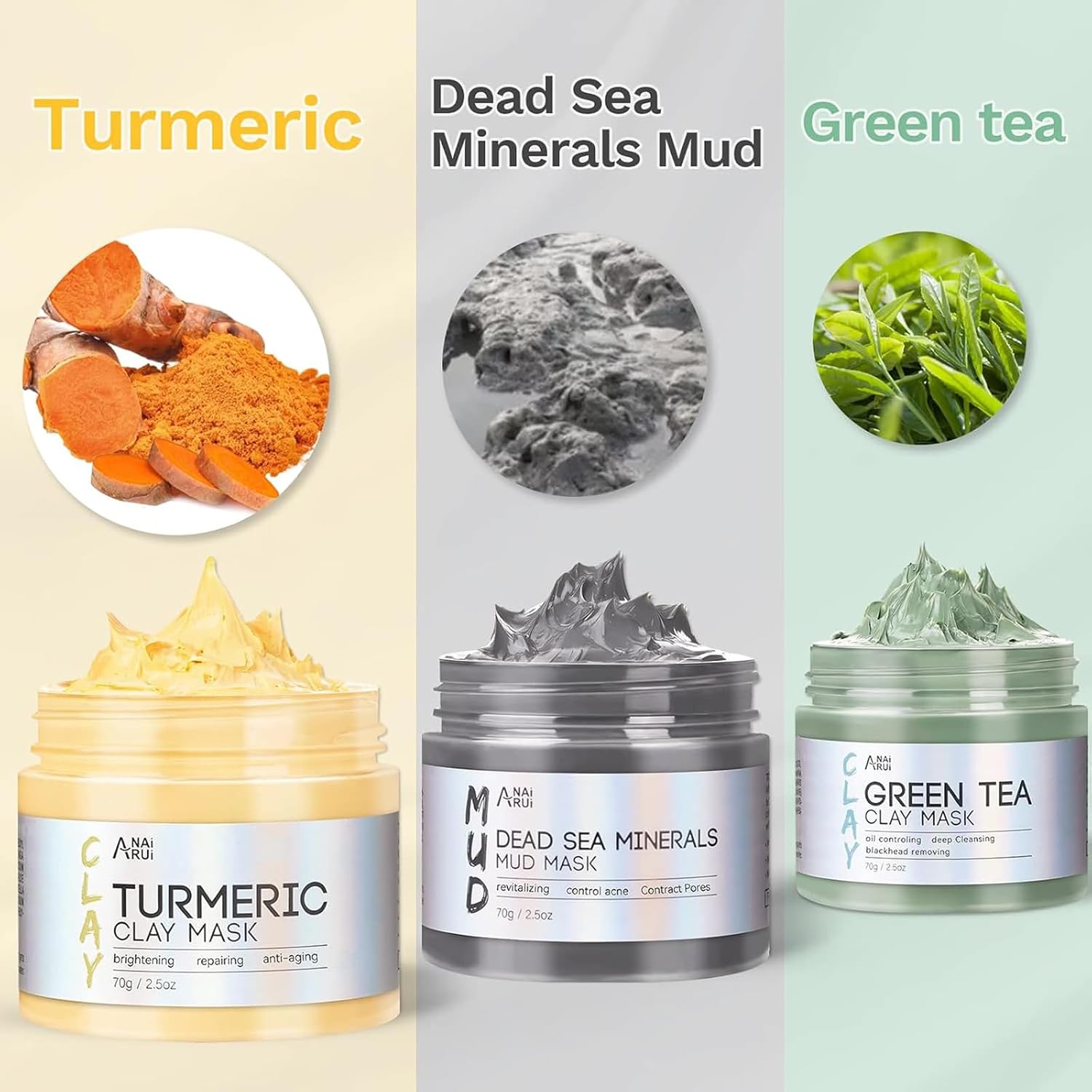
If you have ever stood in a beauty aisle holding a $40 clay mask and thought, I have no idea if this is the right type of clay for my skin — you are not alone, and you are asking exactly the right question. Clay masks are not interchangeable. Kaolin (a fine, white clay that absorbs surface oil gently), bentonite (a volcanic clay that swells on contact with water and pulls more aggressively from pores), French green clay (mineral-dense and best for congested or oily skin), and rhassoul clay (a smoother Moroccan clay prized for conditioning texture) each behave differently on skin and suit different skin types. Buying a full jar — typically 3 to 12 ounces — of the wrong type is a real waste. This is the case gift sets and variety packs exist to solve. This guide walks you through how to evaluate what’s actually in these sets, which formats give you the most useful sampling intel, and how to avoid the common mistake of treating every clay product like it’s doing the same job.
| EDITOR'S PICKPack of 5 Cosmetic Clay Powders… | Mid-tierBentonite (Indian Healing) | Mo… | Budget pick[ClearLee Cosmetic Grade Clay Po…](https://www.amazon.com/dp/B09YTQ7D5D?tag=greenflower20-20) | |
|---|---|---|---|
| Number of clays | 5 | 3 | 5 |
| Clay types | Multani Mitti, Rhassoul, Dead Sea, Yellow, Purple | Indian, Moroccan, French Green | Kaolin, Bentonite, Dead Sea, Moroccan, Rhassoul |
| Weight per bag | 8 oz | — | — |
| Pure natural | — | — | ✓ |
| Suitable for soap | ✓ | — | — |
| Price | $29.99 | $19.99 | $9.99 |
| See on Amazon → | See on Amazon → | See on Amazon → |
Why Clay Type Accuracy Matters Before You Sample
Here is the single most useful frame for anyone building a clay mask rotation: clay type is the first variable, not brand or packaging. Once you have that right, everything downstream — frequency, application time, complementary products — becomes much easier to calibrate.
Paula’s Choice Skincare Education documentation is direct on this point: kaolin is a mild clay suitable for sensitive and dry-combination skin precisely because it absorbs excess sebum without stripping the barrier. Bentonite, by contrast, carries a strong negative ionic charge that binds to positively charged toxins and mineral deposits — useful for oily or acne-prone skin, but genuinely disruptive to a compromised or dry barrier. Rhassoul is mineral-rich in silica, magnesium, and potassium, which is why reviewers at Byrdie consistently categorize it as the clay most appropriate for dry or mature skin types needing both cleansing action and some measure of conditioning.
The practical implication: a variety pack that includes all four of these clay types across four separate applications gives you more diagnostic information than a single full jar ever could. You learn which clay your skin tolerates well, which produces tightness without payoff, and which leaves your skin looking genuinely cleaner and calmer by the next morning.
Ingredient conflict checkpoint — mandatory before you sample anything: Every clay mask, regardless of type, should be treated as an exfoliating step. Allure’s ingredient conflict guidance notes that clay masks used on the same evening as retinoids, AHAs (alpha-hydroxy acids like glycolic or lactic acid), BHAs (beta-hydroxy acids like salicylic acid), or high-concentration vitamin C serums compound irritation risk — especially for first-time users. When sampling a new clay format, use it on a night when the rest of your routine is deliberately minimal: gentle cleanser, the clay mask, a plain moisturizer. This is not a conservative-for-no-reason recommendation. It is the only way to isolate what the clay itself is doing to your skin.
Reading a Gift Set Like a Practitioner: What the Format Tells You
Not all variety packs are built for sampling with the same intelligence. Here is how to evaluate format before price.
Single-use foil sachets (typically 0.1 to 0.3 oz each): The most honest sampling format. One application is genuinely enough to assess immediate skin response — pore appearance, texture, tightness level, sensitivity reaction — though it won’t reveal cumulative benefits. Look for sets where each sachet is a distinct clay type, not the same formula in three different scents.
Mini jars (0.5 to 1 oz): Two to four applications, which is enough to move from first-impression to pattern recognition. If your skin looks better after three uses of a particular clay, that’s a signal worth acting on. Mini jars also let you sit with a product long enough to assess how it performs across different weeks of your hormonal cycle, season changes, or during periods of elevated stress — all of which affect sebum production and barrier function.
Curated brand sets (one brand, multiple formulas): These are high-quality if the brand genuinely differentiates its clay formulas by type and skin target. They are less useful when the “variety” is really just texture variation (cream vs. wash-off gel) within the same base clay. Read the ingredient list, not just the marketing header.
Multi-brand department store gift sets: Highest potential range, highest noise-to-signal ratio. These sets are often assembled around gift-giving aesthetics rather than sampling logic. They may include a kaolin cleanser, a bentonite spot treatment, and a rhassoul single-use mask — technically a variety of clay formats, but not necessarily useful as a controlled comparison because the delivery systems differ too much.
By the Numbers
| Clay Type | Primary Benefit | Best Skin Target | Typical Full-Size Cost |
|---|---|---|---|
| Kaolin | Gentle oil absorption | Dry-combination, sensitive | $10–$65 |
| Bentonite | Deep pore purging | Oily, acne-prone | $8–$45 |
| French green | Mineral detox, congestion | Oily, normal-oily | $25–$85 |
| Rhassoul | Cleansing + conditioning | Dry, mature | $35–$130+ |
Where Gift Sets Actually Live in the Market (and What They Cost Per Application)
The cost-per-use math on gift sets is not always flattering to the gift set, and it pays to run the numbers before assuming you’re getting a deal.
Entry tier ($10–$30 sets): Aztec Secret Indian Healing Clay in its standard jar is $10 to $15 for 1 pound — already an extraordinary cost-per-use proposition at the single-ingredient bentonite level. Entry-tier gift sets in this range typically pair it with a kaolin-based cleanser or a sheet mask. Useful if you haven’t tried bentonite. Less useful if you’re already comfortable with bentonite and need to move into green clay or rhassoul territory.
Mid tier ($35–$85 sets): This is where the sampling value peaks. Sets from brands like Herbivore, OSEA, and Tatcha at this price level often include legitimate mini-jar quantities of distinct formulations. Byrdie’s editorial coverage of the best clay masks in this tier regularly notes that the Herbivore Blue Tansy Resurfacing Clarity Mask — built on white willow bark and blue tansy oil alongside a kaolin base — is one of the cleaner formulations at mid-tier for sensitive-oily skin. A set that includes a 1 oz mini of this alongside a bentonite-forward formula gives you an immediately useful A/B comparison.
Prestige tier ($90–$200+ sets): Sisley Paris, La Mer, and Phytomer sets in this range are not primarily sampling vehicles — they are gifting propositions where the brand experience is part of the value. That said, the Dermstore editorial team’s gift set coverage notes that prestige sets do occasionally include genuine deep-dive minis (1 oz or larger) of hero formulas. If you are evaluating a $350 La Mer Lifting Contour Mask before committing, a prestige set that includes a 1 oz version at $120 to $140 is a rational cost-per-use decision: you’re paying roughly $30 to $40 per application versus the full-size’s $35 to $40 per application, with the option to walk away if it doesn’t perform for your skin. The math often comes out closer than people expect.
Professional and esthetician-adjacent sets: Eminence Organics and Bioelements both offer trial and professional sampling kits, typically sold through their professional channels or authorized spa distributors. These are built for exactly the diagnostic purpose this article covers — allowing a practitioner or prosumer to assess multiple clay formats under the same application protocol. If you’re sourcing for treatment room use, these kits are the most cost-efficient entry point before placing a bulk professional order.
How to Structure Your Sampling Rotation
Sampling without structure is just collecting. Here is a decision frame that generates actually useful data.
Step 1 — Establish your baseline. One week before starting any sampling rotation, note the following: average oiliness at T-zone by midday (on a 1–5 scale), frequency of visible congestion or blackheads, and how your skin responds to a standard clay cleanser (tightness, redness, smoothness at 30 minutes post-rinse). This is your control.
Step 2 — Sample one clay type per week, same night of the week. Consistency of timing matters. If you mask on Tuesdays, keep it Tuesdays. Skin behavior varies across the week and menstrual cycle; random timing introduces variables that make comparison unreliable.
Step 3 — Note four data points per use: immediate tightness level (1–5), redness at rinse-off, skin texture at 30 minutes, and skin appearance the following morning. Three applications is the minimum to establish a pattern with a mini jar.
Step 4 — Apply the ingredient conflict protocol every time. No retinoids, exfoliating acids, or vitamin C that evening. This applies even when you think you know how your skin will respond. The goal is isolation, not efficiency.
Step 5 — Run the cost-per-use math before buying full size. Take the retail price of the full jar, divide by the number of applications (most brands estimate one application per ¼ to ½ teaspoon for a full face), and compare that figure to the cost-per-use you paid in the sample set. For prestige buys at $100+, this math should always be explicit before committing.
The Decision Rule
If the clay type you sampled left your skin visibly cleaner, texture-improved, and non-irritated across three uses — with no adverse reaction in the 48 hours after each application — that formula has cleared the basic threshold for full-size investment.
If the clay produced tightness that persisted beyond one hour post-rinse, visible redness, or increased sensitivity in the days following, that clay type is working against your barrier, not with it. Move to the next type in your sampling rotation.
If you are buying for a treatment room, the decision rule is the same, applied at scale: sample the professional kit, document client responses across three to five sessions per formula, then place your bulk order based on which clay type generates the clearest positive pattern across your client demographic. Eminence Organics and Bioelements both publish professional usage guidelines that include application timing and contraindication notes — those documents should be your reference before introducing any new clay format into a treatment protocol.
The full-jar commitment is the easy part. The sampling rotation is where the actual knowledge gets built.